
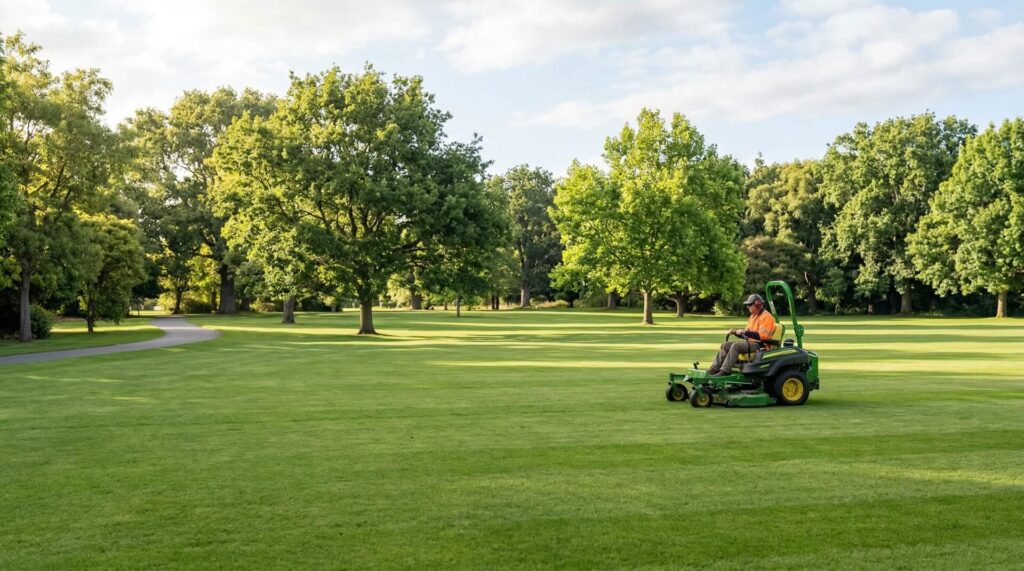
When people hear grounds maintenance, lawn mowing is often the first thing that comes to mind. But looking after a commercial property, school, park or public open space involves considerably more than keeping the grass short.
Good grounds maintenance is about keeping an outdoor space safe, functional and presentable throughout the year. Depending on the site, that can involve everything from mowing and garden maintenance to weed control, vegetation management, minor repairs and seasonal tidy-ups.
Just as importantly, the right maintenance programme should reflect how the space is actually used.
More than mowing
Mowing and turf care are an important part of many grounds maintenance programmes, but they’re only one part of the job.
A broader programme might include:
- mowing, edging and line trimming
- garden and planted-area maintenance
- pruning and vegetation management
- weed and agrichemical control
- leaf and green-waste removal
- track, path and hard-surface maintenance
- maintenance around signs, fences and other outdoor assets
- minor landscape repairs
- seasonal clean-ups and one-off improvement work.
The exact mix will vary significantly between sites. A school has different requirements from a retirement village, commercial property or public reserve, so there is little value in applying exactly the same maintenance specification everywhere.
Grounds maintenance should respond to the site
One of the biggest differences between simply carrying out a list of tasks and properly managing a site is recognising what actually needs attention and when.
Grass growth is a simple example. A rigid mowing frequency might work for part of the year, but Canterbury’s growing conditions change considerably between spring, summer and winter. The same applies to weeds, planted areas and vegetation.
Effective grounds maintenance should respond to those seasonal changes while still delivering the standard expected by the client.
It should also take account of how different parts of a site are used. High-profile entrances may need a higher presentation standard, while less visible areas can sometimes be managed differently. Spaces used by children or the public may require particular attention to visibility, access and potential hazards.
That approach can produce a better result without simply increasing the amount of maintenance being undertaken.
What about open spaces and public areas?
For larger sites, grounds maintenance often overlaps with open space maintenance.
Parks, reserves, schools, community facilities and other public spaces can contain a mixture of turf, gardens, native planting, paths, structures and other assets. Maintaining them effectively means considering the space as a whole rather than treating each component in isolation.
For example, vegetation may need to be managed to keep paths accessible and sightlines clear. Weed control around young native planting can be important for successful establishment. Drainage or surface issues may become apparent during routine maintenance and need to be addressed before they become larger problems.
Regularly having experienced people on site also means emerging issues can be identified early.
Routine maintenance versus one-off work
Not every site needs a full grounds maintenance contract.
For some organisations, scheduled maintenance throughout the year provides consistency and makes budgeting easier. For others, the better option may be periodic or seasonal work — such as a spring tidy-up, vegetation clearance, garden renovation or preparation of a site before an event.
There can also be value in combining the two.
A regular maintenance programme can cover the predictable work, with additional projects undertaken as required. This is particularly useful for larger properties and open spaces where priorities change over time.
What should you look for in a grounds maintenance contractor?
Price matters, but it shouldn’t be the only consideration.
For organisations responsible for staff, visitors, students, residents or members of the public, contractor health and safety systems, staff competency and appropriate insurance are important. Depending on the work involved, relevant training and certification for machinery or agrichemical use may also be required.
It is also worth considering how the contractor deals with work that falls outside the original maintenance schedule.
Can they identify an issue and recommend a practical solution? Can they undertake minor improvement work themselves? And can the maintenance programme change as the property or client’s priorities change?
The best arrangement is usually one where the contractor understands the site rather than simply completing the same task list at every visit.
Grounds and open space maintenance in Canterbury
NatureBase provides grounds and open space maintenance across Canterbury for councils, schools, commercial organisations and other organisations responsible for outdoor spaces.
Our work ranges from regular grounds and vegetation maintenance through to one-off tidy-ups, planting, landscaping, environmental management and outdoor asset works.
Because our team works across both grounds and environmental services, we can also look beyond routine presentation and consider how planting, vegetation, public use and other outdoor assets interact across a site.
If you’re reviewing how your grounds are currently maintained, or have a site that needs some attention, get in touch with NatureBase to discuss what would suit the property.