
It’s no secret that councils across New Zealand are facing increasing financial pressure. Local authorities are being asked to deliver and maintain an enormous range of services and infrastructure, while navigating rising costs, ageing assets, growing compliance obligations and the prospect of future rates caps.
In amongst all of that are the green assets councils own and maintain – parks, reserves, sports fields, streetscapes and public open spaces. They’re often highly valued by communities, but they also come with ongoing operational costs that don’t disappear once the ribbon is cut. Mowing, planting, irrigation, playground maintenance, renewals and general upkeep all add long-term pressure to already stretched budgets. Which raises an important question: as councils look more critically at spending over the coming years, how will existing parks and reserves fare in budget discussions?
Adding new green assets that require ongoing maintenance can feel like moving in the wrong direction when it comes to balancing the books. And from an operational perspective, many small parks can indeed be more expensive to maintain than fewer, larger ones. Travel time, setup, and fragmented workloads all add up. But that’s only one side of the ledger.
What small local parks actually do
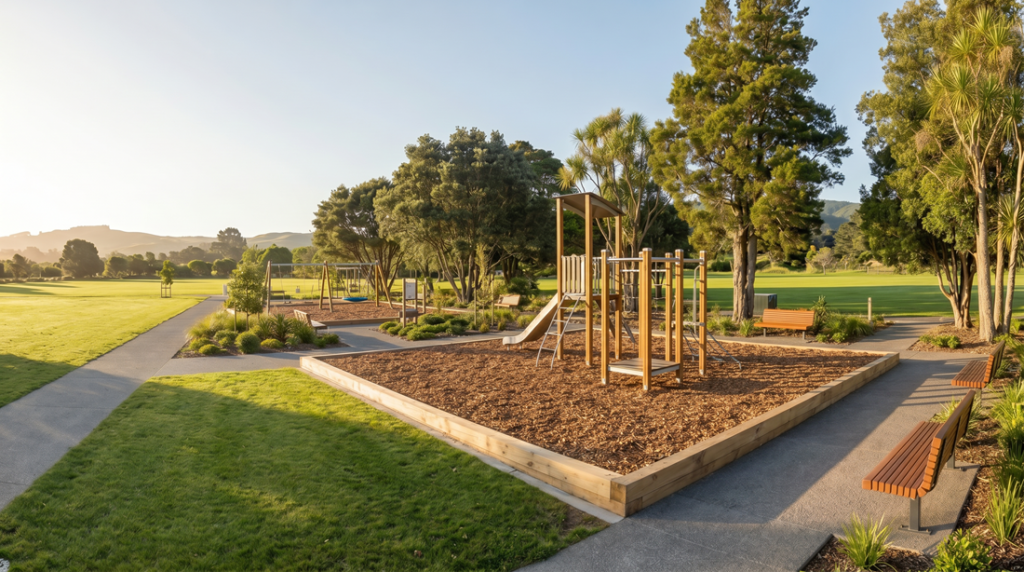
In modern subdivisions, where private outdoor space is often limited, local parks play a different role than traditional large reserves. They can provide accessible recreation space for children, families, and communities – particularly important for those without access to vehicles to visit larger urban parks. They can contribute to stormwater attenuation and flood mitigation through increased permeable surfaces. They can also support urban biodiversity, even at small scales. While individually these benefits might seem modest, collectively they can play a big part in shaping how a new neighbourhood functions.
The Real Issue: What We Count (and What We Don’t)
The problems arise when we try to measure the value of these small neighbourhood parks. The costs of managing green assets are immediate and clearly visible on council balance sheets. Maintenance, renewals, and ongoing upkeep – they’re all easy to quantify. But the benefits are harder to capture in the same way. That doesn’t mean they lack value – it simply means the value is measured differently.
These spaces are part of our natural capital, and they provide a range of environmental, social, and economic benefits that aren’t easy to quantify in a budget. For example, if a park helps reduce stormwater pressure, that can mean less money spent on pipes and infrastructure over time, but that saving doesn’t sit neatly alongside the parks budget. If people are more active because they’ve got somewhere close to walk or bike, there are real health benefits, but again, that value sits somewhere else in the ledger.
Even something as simple as property value uplift from proximity to green space tends to benefit the wider rating base, rather than the specific asset that helped create it. So on paper, new parks can start to look like a cost-heavy asset. But when you step back and look at the broader system, they’re often doing the work of multiple assets at once – just in a way that’s harder to quantify on the balance sheet.
So, Where To From Here?
The choice between “more small parks” and “fewer large parks” may be a necessary one as councils grapple with tightening budgets. But, is there room for being more deliberate about how these smaller assets are designed, delivered, and managed before they get put on the chopping block? For example, is there an opportunity to design spaces differently from the outset?
Not every park needs to be a neatly mown grass reserve. Could smaller areas of usable open space be combined with lower-maintenance planting and slower-growing groundcover to reduce ongoing costs, while still delivering valuable recreational outcomes? Or is there scope to be more strategic about how open space is delivered through development?
In areas where there’s already good provision within walking distance, could financial contributions be ringfenced for use in existing parks rather than continuing to add smaller sites into the network? And then there’s the question of long-term responsibility. Is there room to think differently about how and when assets are handed over? Whether developers carry maintenance for longer, or whether there are models that encourage more local ownership and stewardship of these spaces?
None of this is simple, and it won’t look the same in every district. But these fiscal challenges present a real opportunity to recognise the full role these spaces play, to design them more deliberately, and to manage them in a way that reflects both their cost and their value.
The affordability of maintaining local parks is a genuine issue, and one that will require some tough conversations and creative thinking in the not too distant future. But as that happens, it’s important that the ledger is balanced by properly recognising the benefits these spaces provide, alongside the costs of maintaining them.