
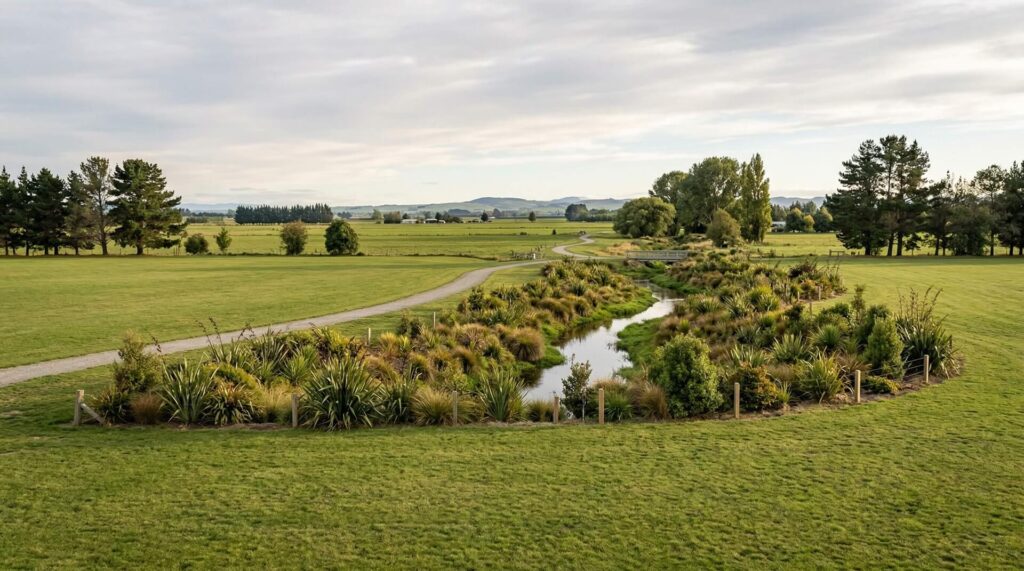
At face value, installing park furniture like benches sounds straightforward. No significant earthworks. No major infrastructure. Just a small addition to improve how people use a space. But when that space is a stormwater basin, stream corridor or constructed wetland, even minor works can become more complex from an environmental and planning perspective.
When Constructed Environments Raise Classification Questions
Under New Zealand’s environmental legislation, not all wetlands are treated the same.
Deliberately constructed features, such as stormwater basins or treatment wetlands, are generally excluded from the definition of a natural inland wetland. Wetlands that develop over time in or around constructed water bodies may also fall outside that definition.
The definitions themselves are relatively clear – the challenge is applying them to real-world sites. In many open space environments stormwater systems are integrated with restoration or naturalisation projects, planting programmes are designed to achieve ecological or biodiversity outcomes, and sites may have been modified, extended or repurposed over time In these situations, it is not always straightforward to determine whether a feature is considered deliberately constructed, how it relates to surrounding natural systems or how the relevant definitions should be applied in practice.
Even where a feature is ultimately excluded from the definition of a natural inland wetland, other regulatory controls may still apply depending on the activity and site context.
Why This Matters For Minor Works
For small projects like installing park furniture, the activity itself is typically low risk. However, when works are located within or near stormwater systems, stream margins or areas with ecological or restoration values, the regulatory pathway can become less straightforward. Even where activities remain permitted, confirming that often requires interpretation of definitions, understanding of site history and function, and alignment with regional plan rules and overlays. Without that upfront consideration, minor works can face delays, additional cost and uncertainty during delivery
Bridging The Gap Between Policy And Practice
Environmental management in open space environments sits at the intersection of planning frameworks, asset management requirements and practical delivery on the ground Understanding the rules is only part of the equation. Equally important is understanding how those rules are applied in practice, how councils interpret them and how to plan works so they remain compliant without unnecessary complexity
A Practical Aproach
For works in or around stormwater systems, stream corridors or potential wetland environments, a few simple steps can make a significant difference:
- Check early whether wetland definitions may be relevant
- Understand the planning framework before works are scoped
- Consider how the site is classified and functions in practice
- Align design and installation methods with environmental constraints
- Document the approach where required to support compliance
These steps are not about overcomplicating minor works – they are about avoiding avoidable issues.
The Takeaway
What looks like a minor job on site can sit within a much broader environmental and planning framework. Understanding that early allows you to make informed decisions, avoid delays and rework, and deliver projects that meet both operational and regulatory requirements For councils and organisations managing open space networks, this is becoming increasingly important as environmental expectations and regulatory frameworks continue to evolve.